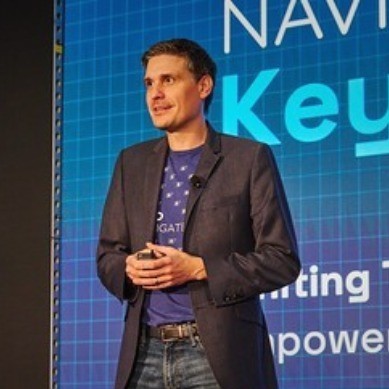
Over the past few years, Civo Navigate has become a useful barometer for where cloud and AI are heading. Our first event in Florida back in 2023 captured the early wave of AI enthusiasm. Conversations were exploratory; full of curiosity about what cloud-native infrastructure could enable in this new age of machine learning.
By the time we reached Berlin last year, the focus had shifted. The conversation was no longer about if businesses should engage with AI, but how. Developers and decision-makers were asking tougher questions about scalability, cost, and regulatory exposure.
Now, as we look ahead to Civo Navigate London 2025 in September, the focus has shifted once again, this time reflecting a more mature, more politically aware industry. We’re asking important questions like who controls the infrastructure that AI relies on, where data resides, and how technology and policy can align to create systems that are transparent and built to last.
Why sovereignty now?
This year, we’re introducing a new session to the agenda: a flagship panel on digital sovereignty. The session will open with remarks from The Rt Hon Lord Maude, former Cabinet Office Minister and a key figure in reshaping how the UK government approaches technology. Back in 2011, he was behind the creation of the Government Digital Service (GDS), the team that built gov.uk and set the standard for modern, user-focused digital delivery in the public sector. He’s long been a champion of transparency and doing things smarter when it comes to public infrastructure. His experience sits right at the intersection of policy, procurement, and tech, making him an ideal voice to help frame this conversation on digital sovereignty.
Panellists include:
- Dr Ben Spencer MP, Shadow Minister for Science, Innovation and Technology
- Johan David Michels, Cloud Legal Project, Queen Mary University of London
- Greg Noone, Editor at Tech Monitor
This discussion couldn’t come at a more critical time. Across the UK and Europe, momentum is building for reform around cloud infrastructure and control. In the UK, the Competition and Markets Authority (CMA) has just released its cloud inquiry findings, calling out the dominance of US hyperscalers. At the same time, the debate over sovereignty has intensified following Microsoft’s testimony before the French Senate, where the company admitted it “cannot guarantee” data sovereignty for customers in France, or anywhere in the EU, under US law.
Behind the scenes, trade tensions and the scramble for control over semiconductor supply chains have made one thing clear: our digital infrastructure still relies heavily on a small handful of global players. That kind of concentration brings real risk, especially when political or economic conditions shift.
This is the backdrop for Civo Navigate London 2025. Our flagship panel on digital sovereignty will explore how the UK can take practical steps to build resilient, open, and future-ready infrastructure at a time when both the risks and opportunities are growing.
The value of cross-sector dialogue
One of Navigate’s strengths has always been the breadth of voices in the room. Alongside engineers and DevOps professionals, you’ll find legal specialists, policymakers, researchers, founders, and journalists contributing to the conversation.
This kind of mix is important when discussing such multifaceted issues like digital sovereignty. Technical decisions around infrastructure often intersect with legal frameworks, procurement constraints, and national policy goals. Each of these groups brings a different kind of expertise, and understanding how they overlap is key to making meaningful progress.
Sessions at Navigate give these perspectives room to interact. They create opportunities for open discussion about real-world trade-offs: transparency versus risk, public interest versus commercial pressure.
Hearing From Kelsey Hightower
We’re also thrilled to welcome back Kelsey Hightower, one of the most respected voices in the global cloud-native community. His keynote will explore the convergence of cloud-native infrastructure and AI and what it means for developers, businesses, and policymakers.
Kelsey has long been a guiding voice in cloud engineering. What sets him apart is his ability to step back and make sense of the broader picture; why we’re building what we’re building, and what we might be missing along the way.
A new chapter for Civo
This year’s Navigate also marks a turning point for us as a company. I’ll be taking the stage to share Civo’s updated vision, one that puts sovereignty and AI at the centre of how we think about infrastructure.
Our new direction reflects the growing need for a cloud that’s easier to control, faster to scale, and better aligned with the realities of today’s regulatory and technical landscape. It’s the next step in Civo’s journey, and I’m looking forward to sharing what comes next.
A preview of Civo Navigate London 2025
As infrastructure becomes more politicised and regulation catches up with innovation, the decisions we make about cloud will define the future of AI. They affect how data is governed, how AI models are deployed, and who benefits from the systems we’re building.
Civo Navigate London 2025 is a chance to engage with those questions directly. Not to settle every debate, but to better understand the different priorities at play and to find shared ground where better infrastructure decisions can be made.
Join us on Tuesday, 30th September 2025, at Convene, 155 Bishopsgate. Find out more and register here.
 Mark Boost