
Multicloud has been hailed as the answer to the cloud conundrum for years. On paper, it promises flexibility and freedom from the grip of hyperscaler dominance. But in practice, few businesses have made it work.
At Civo, our latest research found that while 60% of businesses have moved beyond single-provider cloud models, only 15% have launched a significant data migration in the past year.
So why is progress stalling?
Understanding the multicloud hype
Between Microsoft, AWS and Google, up to 80% of Europe’s cloud infrastructure is controlled by just three companies. That level of concentration is risky in any industry, but when it comes to organisational data stored on cloud, the stakes are even higher.
We’ve already seen how fast geopolitical tensions can spill over into the tech sector. The threat of US-imposed tariffs has sent shockwaves through UK and EU boardrooms, raising real fears about whether continued reliance on American infrastructure is sustainable. There’s growing concern that if costs go up, those price hikes will be passed directly onto customers, especially smaller firms and startups who can least afford it.
On top of that, the more centralised the cloud market becomes, the harder it is for businesses to retain meaningful control over where their data is held and how it’s protected.

I hear this all the time from founders and IT leaders: they don’t want to be caught in the crossfire of a transatlantic trade dispute. But they feel like they’ve got no alternative because moving away from Big Tech is harder than it looks.
Last year, the UK’s Competition and Markets Authority launched an investigation into the dominance of major cloud providers, including Microsoft. In its provisional findings, the CMA raised concerns about restrictive licensing terms that make it harder for customers to run Microsoft software on rival platforms, as well as technical and commercial barriers that make switching providers difficult. The final verdict was: “competition in this market is not working as well as it could be.” As a result, many businesses have found themselves stuck in long-term contracts that no longer meet their needs.
These stories hit a nerve because they echo what I hear from CIOs and CTOs every day. For many UK businesses, the core issue is data sovereignty. That means having clear answers to where their data resides, who can access it, and which legal frameworks apply.
That’s why we’re seeing a shift. Multicloud has been heralded as a way for businesses to regain control by spreading data across providers to reduce risk and avoid over-dependence. On paper, it sounds like the perfect recipe for freedom. But in reality, it’s rarely that simple. So what’s holding it back?
Visibility is limited
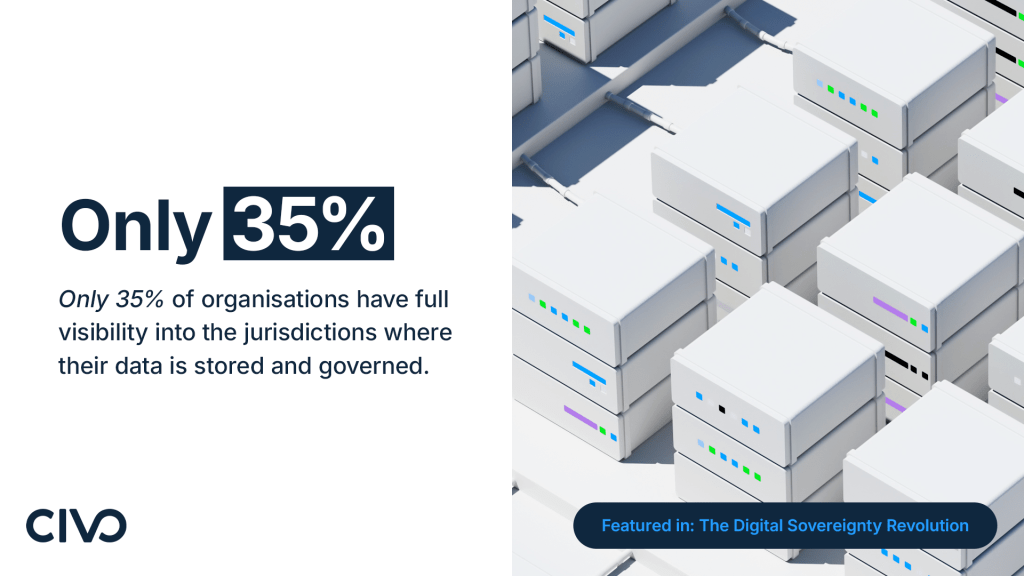
Just 35% of organisations in our survey reported having full visibility into where their data is stored and governed. That’s a worrying figure in a regulatory environment that’s only going to get stricter. Without visibility, it’s incredibly difficult to make smart decisions about infrastructure, compliance, or security, let alone navigate evolving UK and EU sovereignty frameworks.
Complexity slows everything down
While multicloud is often positioned as a route to flexibility, the operational reality is far more complex. Managing multiple cloud platforms means juggling different user interfaces, support models, billing systems, and compliance requirements. Instead of making businesses more agile, this fragmentation adds complexity and drives up overheads. The result is a governance mess: compliance slips and teams lose the agility needed to respond quickly.
Lock-in is still a major obstacle
Even when businesses want to move, most can’t. I’ve heard this time and again from customers who feel trapped inside hyperscaler ecosystems – tied up in proprietary APIs, restrictive licensing agreements, and embedded tooling that’s hard to untangle.
Multicloud, right now, just isn’t delivering on its promise. It’s not wrong in principle but too often, it ends up as a fragmented mess with duplicated costs and teams stretched thin trying to manage incompatible systems. It’s become a halfway house stuck between ambition and execution.
Hybrid cloud: A smarter approach to cloud
Hybrid cloud is the more practical answer. Where multicloud spreads workloads across disconnected platforms, hybrid creates a unified environment, one where private and public infrastructure work together by design. It avoids the integration sprawl of multicloud while still offering flexibility and scale where it’s needed.
For organisations facing growing pressure around data sovereignty and regulatory compliance, hybrid offers a clearer path forward. Sensitive workloads can stay close to home in a controlled environment, while public cloud capacity can be tapped when performance or elasticity is needed.
To make that work in practice, we need cloud platforms that are straightforward to use, fair in pricing, and transparent about control. At Civo, we’ve built our approach around those principles. With FlexCore and our Public cloud, teams get the same experience and feature parity whether workloads are deployed on-prem or in the cloud. The cloud should just work, however you want it.
The future belongs to businesses that can scale on their terms. Not locked into one provider. Not slowed down by complexity. Just in control, by design.
 Mark Boost